
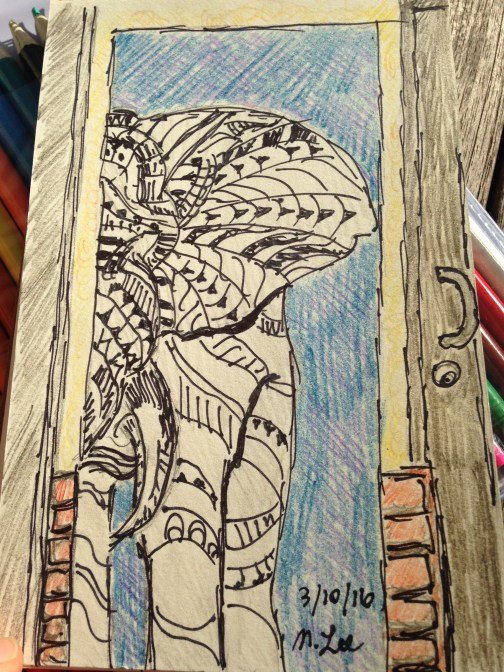
Had lunch outside at an Indian restaurant under the El, which had this beautifully patterned elephant image on its wall. Wonderfully sunny spring day for sketching.
Had lunch outside at an Indian restaurant under the El, which had this beautifully patterned elephant image on its wall. Wonderfully sunny spring day for sketching.
Down Cumberland the kiddie pools have been emptied, deflated, dragged indoors and the old trees are lingering with slow leaves as dusk catches up inch by inch. Past the steepled church of dark red brick that stretches up into the twilight kind of streetlight and its sign that jokes: “Sign broken. Come inside for message,” which has been up for months — past the church at the end of the block the cobblestones begin, stumbling their wide way left and right up Trenton. The uneven sidewalk leads from stoop to stoop, and the houses loom up together, tall with gilded numbers, faded American flags, planters with the vestiges of blooms, windows with cats and conversation pieces and handmade bows. Down Cumberland the men stride out of doors with medium-sized dogs and the women sit out and talk loudly about work while smoking cigarettes, and the ice cream truck makes it last sad attempt at luring customers as its nursery tune fades around the corner, and the kids hide from their fathers at the end of the block until they are called with a holler. And when everything becomes quiet in Fishtown, you can hear the wind begin the season as it takes the first leaf down.
(Poets & Writers’ prompt was to write a piece about a street name. I chose my own — sorry this is late, Gagan! <3)
when the sky was hung
with ten suns
(the story begins)
that terrible era of ash
& air so thick of bone
& spice of ginger root
how they got there emblazed
until all was yellow and grey
no one knew not even
the blind crones with
wood for teeth banging
bowls at their feet
the days of ten suns
precluded no night
no relief of blooming jasmine
wrung around a lattice
rivers & wells shriveled
to scorch of hair
to clap of dry thunder
& fusing metals
all the land a hostage
but nine too many —
farmers shook their
glistening heads
phoenixes drifted out of
cages trailing soot
& no love-making occurred
throughout all those years
generations at a stand-still
it is possible to die
from too much light
possible the obliteration of
entire chronicles of war
of nations by nine suns
too many, so to begin
new histories of rancor
even then, she says
from her lunar perch
in which shadow melts
into shadow
even then was a time
though of no resplendence
of something material:
fever & strange winds
& stranger cravings
for fruit & tears &
docile daughters
until her husband
archer among the ranks
of men, with his ardent bow
and arrow struck straight
the nine oppressive orbs
(which ones counterfeit?)
& they came tumbling fast
down to Earth smothered to ash
& the grasses grew
& horses cantered by streams
swelling up again the banks
& oceans fierce with tide
the moon is no comfort
how I would’ve died then,
she says, for a stretch of
twilight, but the journey
was inexorable —
the elixir mistakenly swallowed,
the rise and pull up into
celestial abyss, black hair
streaming in vertigo
of absence
which is the same
vertigo now as she sits
under the leafless cherry tree
sprouting from luminescence
of moon rock,
where the Earth from afar
is so changing and blue
here where dark and light are
one and the same darkness
(P.S. Wifey, I think it’s interesting [or predictable?] we both titled our poems the names of our folktale women, and that they also both have inner monologues. <3)

 mabel lee